
BAKE: Leading AI Literacy in Education.
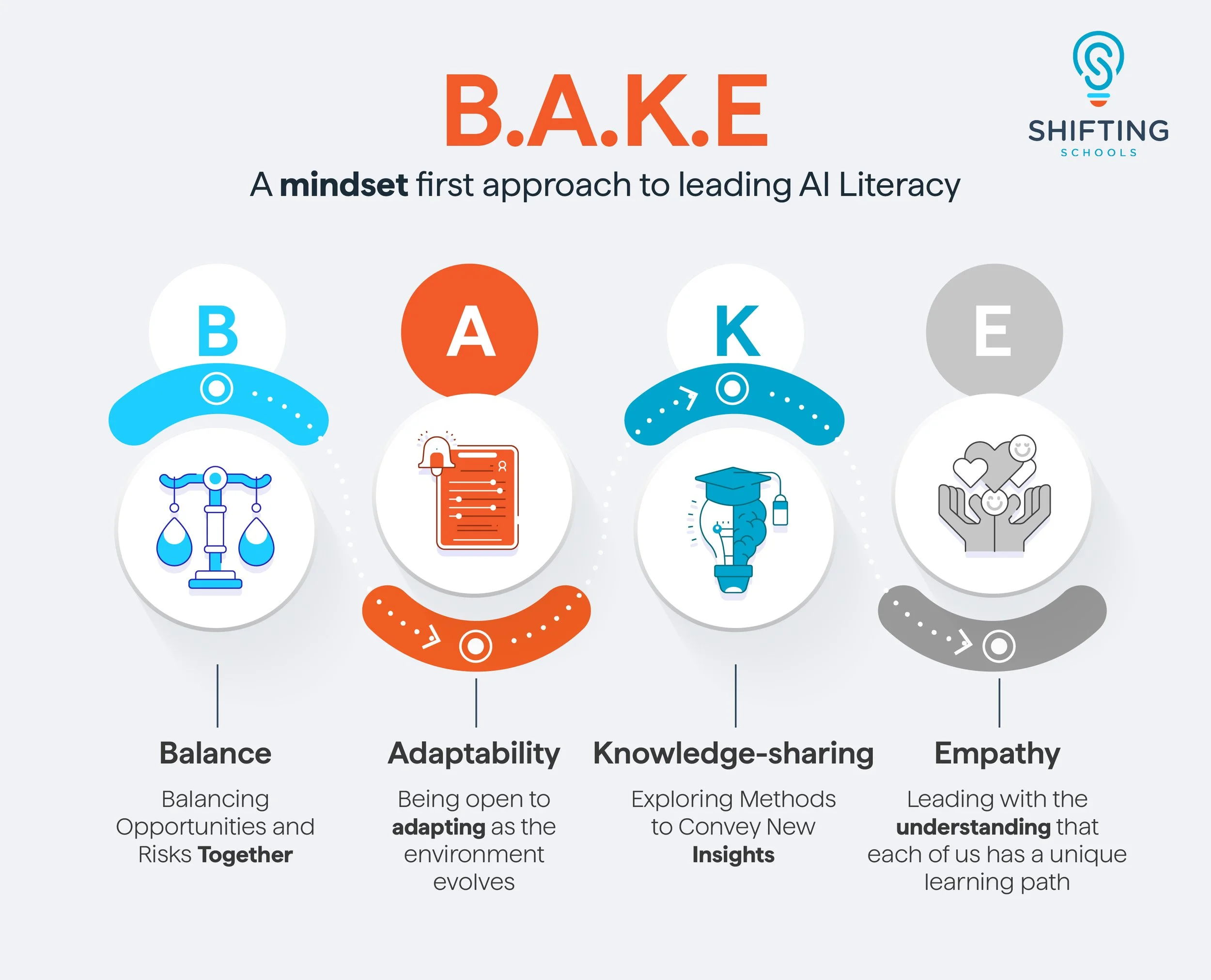
BAKE is a mindset-first AI literacy framework for K-12 school leaders, built on four pillars: Balance, Adaptability, Knowledge-Sharing, and Empathy.
A framework for school leaders who are tired of reacting to AI—and ready to lead with clarity.
School leaders have hard questions to address:
Those struggling most aren’t missing tools or policies.
They’re missing a shared way of thinking about uncertainty, learning, and change.
That’s why we created the BAKE mindset framework.
The BAKE Mindsets
Balance
Adaptability
Knowledge-Sharing
Empathy
Four Weeks with Research-backed Support.
Four newsletters with tools and menus.
Plus all resources bundled in our BAKE eBook.
Weekly online support.
Our eBook sets you up to pilot your own PLC.
Human-centred AI literacy for K-12 school leaders. BAKE offers four pillars, 10 field tools, and a practical cadence for leading change with judgment.
A 55-minute live online workshop.
Build a human-centred approach to AI through practical reflection, shared language, and field-ready tools leaders can use right away.
*purchase includes access for 20 participants
Why Mindsets Come First
Schools using a mindset-first approach:
Move from compliance-driven rules to confidence-driven decisions
Build communication habits that benefit the broader community
Replace mixed messages with shared language to cultivate trust
When tools evolve weekly, consistency doesn’t come from rules…
it comes from how we think, decide, and collaborate.
Most AI literacy frameworks chase the tool. BAKE trains the thinking.
Built for the leader who has to hold policy, people, and practice in the same week — while the ground keeps moving.
Mindsets outlast tools.
The tools change weekly. Your policies can't keep up.
BAKE trains the instincts and habits that carry forward — so when the next agentic model or companion AI arrives, your staff already has the thinking to hold it steady.
Designed for the whole building.
Your staff confidence is all over the map. Most sharing cultures only make space for the loudest 3%.
BAKE's Knowledge-Sharing pillar is built on Wenger's communities of practice research — the colleague who hasn't tried AI yet, and the one who only uses it at home, are already legitimate members. You design for all four kinds of explorer, not just the power users.
Research, not rhetoric.
The public conversation is trapped between hype and fear. Leaders are asked for answers they don't yet have language for.
Every pillar is grounded in current research — Brookings, Stanford, UNESCO, McKinsey, Wenger, Zaki, Bloom, De Freitas. When a board member or family asks what the evidence says, you have real answers, not slogans.
Four mindsets. One loop.
Balance listens. Adaptability moves. Knowledge-sharing travels. Empathy lands. Click a letter to explore the practice underneath it.
A tree leaning into wind is doing the work of staying upright while the conditions around it move.
Balance is not neutrality. It is not the middle of the road.
When you name an AI opportunity, can you name the risk baked into it? When you name a worry, can you name what is genuinely working?
Brookings (Winthrop et al., 2026) reminds us that risks are currently overshadowing benefits in the public conversation. Stanford's 2026 evidence review shows gains often vanish when the tool is removed. Balance is how a leader hears the full picture before deciding.
Some things in your building were built to hold. Some were built to transform. Knowing the difference is the work.
Adaptability is the capacity to redesign practice without losing educational purpose, human agency, or ethical judgment.
The tools will change weekly. The core question does not: what is this moment asking us to rethink — and what are we being asked to protect?
McKinsey's 2025 global survey found 88% of organizations using AI, but only 39% seeing bottom-line impact. The differentiator is workflow redesign, not tool adoption. The same pattern is arriving in schools.
Knowledge-sharing is a leader's design job. Not a motivational speech.
On any given staff right now, you have four kinds of AI explorer: those who haven't tried it, those who only use it at home, those trying it tentatively at work, and those deep in it professionally.
Most sharing cultures only make space for the fourth. That is a design choice. And it is the wrong one.
Etienne Wenger's work on communities of practice (1998) gives us the move: legitimate peripheral participation. People share when sharing has a place to go, and a time to happen. Everything else is exhortation.
Describing someone's experience in their own words, accurately enough that they would recognize themselves in what you say back.
Empathy is not walking in someone else's shoes. That metaphor is warm, old, and — for the work you are being asked to do — the wrong shape.
It is a practice. It is also a boundary.
Jamil Zaki treats empathy as a skill that can be strengthened (2019). Paul Bloom separates feeling-with from understanding-from and argues leaders need much more of the second (2016). AI can simulate the first. Only adults can do the second.
Have questions about bringing our mindset-first approach to your non-profit, district or broader community?
contact: info(at)shiftingschools.com
BAKE is shaped by two people who have spent their careers supporting educators.
Here's who you're learning with.
Tricia Friedman
Works with K-12 leaders around the world on futures literacy, AI literacy, and the practice of leading through contested change. Builds custom bots, writes the AI Forward Substack, and co-hosts the Shifting Schools Podcast. Based in Ottawa.
Connect with TriciaJeff Utecht
Twenty-plus years helping schools make sense of emerging technology — from 1:1 rollouts to AI strategy. Works with districts on professional learning and systems-level change, and co-hosts the Shifting Schools Podcast with Tricia.
Connect with Jeff